Pollen can trigger everything from itchy eyes to serious asthma attacks, and for the first time Maine has near real-time pollen data to help people plan and protect their health. This new data launch also marks one of the first uses of AI-powered pollen monitoring in the state. Explore the data.
New dashboards for Mainers
The MaineTracking Program, in partnership with the Maine Department of Environmental Protection’s (DEP) Bureau of Air Quality and Mi’kmaq Nation Environmental Health Department, is launching a new series of pollen dashboards that provide hourly, daily, and weekly summaries of pollen “misery index” values for five locations across the state - Augusta, Bangor, Cape Elizabeth, Presque Isle, and Rumford. These dashboards give residents, clinicians, and community partners an at-a-glance view of how pollen conditions vary on a given day.
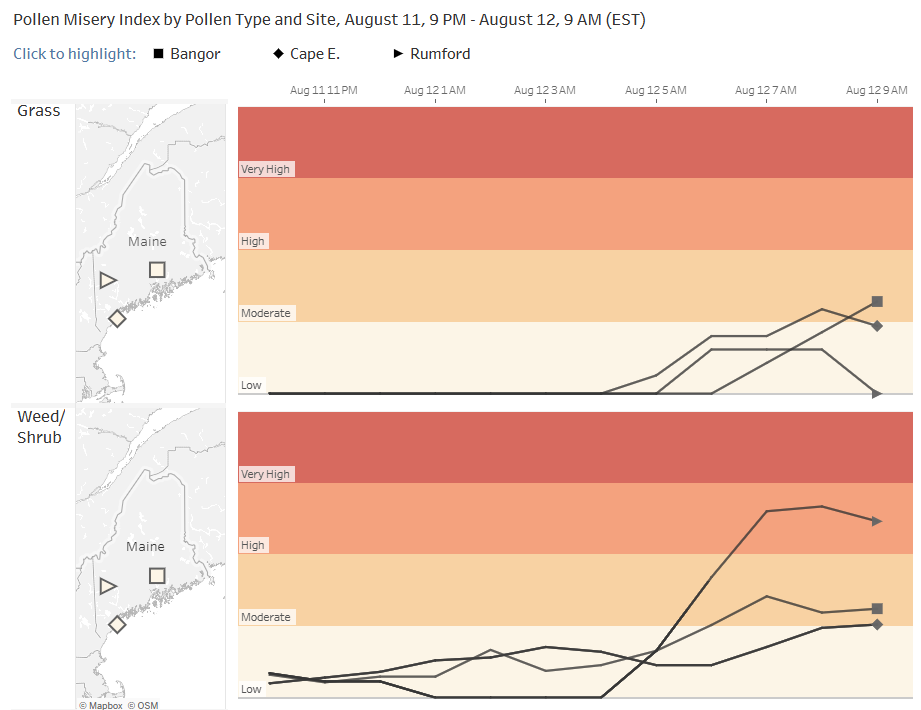
Because pollen seasons are getting longer and more intense, having local, near real-time data helps Mainers decide when to take protective actions against pollen, such as keeping windows closed, limiting time outdoors, or taking allergy medications. The dashboards are designed to be easy to use on both computers and mobile devices, so people can quickly check conditions and make a plan for their day, whether out for a run, working in the yard, or sending kids to outdoor activities.
Cutting edge, AI-powered pollen monitoring
This project is possible through a collaboration between Pollen Sense, Inc., the Maine DEP, the Mi’kmaq Nation Environmental Health Department, and the Maine Center for Disease Control’s MaineTracking Program. Pollen Sense provides the physical sensors and advanced data processing, Maine DEP and the Mi’kmaq Nation place and maintain the monitors, while MaineTracking receives, processes, and turns the data into public dashboards and other data tools.
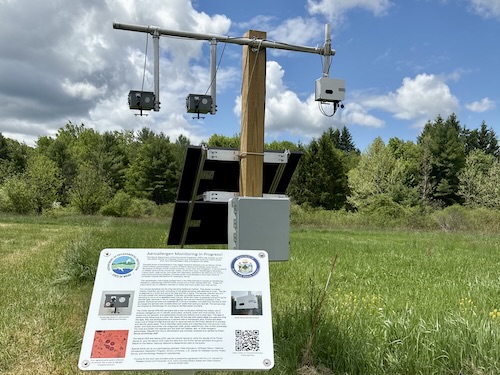
Pollen Sense monitors are small boxes that draw in air and capture particles on a roll of sticky tape inside the device. Digital images of the tape are taken at microscopic resolution every few minutes, creating a continuous record of what is in the air. Those images are then sent over the internet to Pollen Sense’s servers, where software uses complex algorithms and artificial intelligence to identify, categorize, and count pollen grains and other particles.
Because this is cutting edge technology and a bit like a live “beta test”, the system is still evolving and some data gaps or missing periods during which a sensor is offline may occur. Even with occasional gaps, this automated, AI-driven system represents a major leap forward compared with traditional manual pollen counting that can take days or weeks to produce results.
Why this matters for public health
For many people with allergies or respiratory conditions like asthma, pollen can mean missed work or school, poor sleep, and more visits to the doctor or an emergency department. Timely, location-based pollen information helps people and providers act earlier – whether that is adjusting medications, rescheduling outdoor events, or taking simple steps like showering after being outside.
By making this information free and easy to access, the MaineTracking Program is giving Mainers a new, data-driven way to stay ahead of pollen season. As this technology continues to improve, feedback from residents and partners will help us refine these tools and ensure they deliver the most useful, actionable information possible. Over time, this growing record of pollen data will also support climate and health research by documenting how the timing, intensity, and geographic spread of pollen seasons change as Maine’s climate warms, and by informing future research on how shifting pollen patterns affect respiratory diseases like asthma and allergic rhinitis.